
Prentiss County Jail Release Paths
A person can leave Prentiss County Jail through more than one route. Bond may permit a person to leave while the case remains pending. A judge may order discharge, a local sentence may end, or a sentence may be credited as time served. Those events can lead back to the community. None of them should be inferred from the person's absence alone. The recorded event and the legal order establish the route.
Other departures continue custody. The receiving agency may be the Mississippi Department of Corrections, another county, a federal authority, or a different custodian. A detainer is a request or legal basis for another agency to take custody. When one applies, release by the Prentiss County Sheriff's Office can be a direct handoff. Ask for both the destination and the exact event wording. The full county search and record path is also set out on the Prentiss County released inmate search.
| Recorded path | What it means | Best confirmation |
|---|---|---|
| Bond or court discharge | County custody ends under legal authority | Jail docket plus filed court order |
| Time served or local completion | The local custody term has ended | Release entry plus judgment |
| Transfer to MDOC | State custody continues | Jail transfer entry plus MDOC location |
| Other agency transfer | Custody continues with the receiving authority | Destination in the jail record and receiving record |
Confirm Prentiss County Jail Release
Prentiss County publishes no official online jail roster or recent-release list. A blank web search is therefore not meaningful evidence. Start with the jail direct line and ask if the named person is presently held. If not, ask whether the last event was a community release, a transfer, or another custody change. Use a full name, spelling variants, and an approximate booking date. A birth date or booking number can help distinguish people, but ask how to send sensitive identifiers safely.
Follow the live answer with records that can be saved and compared. The county confirms that the sheriff keeps a jail docket. Mississippi SAVIN, delivered through VINELink, can report a release, transfer, or escape event for a registered person. The court file supplies the order behind bond, dismissal, sentence, time served, or commitment. These sources should agree on the person and event even though they serve different roles.
- Call the jail at 662-728-2016 and ask about current custody.
- If the person is absent, request the last event type, time, and destination.
- Review any VINELink or MS SAVIN notice and preserve its reported time.
- Request the existing jail-docket or booking/release entry.
- Match the event to the filed bond, disposition, sentence, or commitment order.
Note: A custody-event alert is useful for timing, but the originating jail record is the stronger documentary confirmation.
Prentiss County Jail Release Records
A focused request should seek an existing record, not ask the sheriff to create a new account of events. Identify the person and a narrow date range. Ask for the booking or docket entry showing the actual date and time custody ended, the recorded release reason, the releasing order or authority, and any transfer destination. Booking number, cause number, bond notation, and a booking photograph may also be requested if those items exist in the file. The sheriff has not published the exact docket schema, so phrase each item as a requested element rather than a guaranteed field.
No local release-record form, local price list, or local turnaround schedule is published. Call first to learn the records custodian's preferred written channel. The sheriff's online contact form warns that it is not monitored at all times and that sensitive information should not be sent through unencrypted email. Ask for an estimate before costs are incurred. Mississippi public-record rules allow actual search, review, copying, and mailing costs, while exempt material may be redacted.
The sheriff's entry establishes the operational exit. A court order explains legal authority. If information is withheld, request a written denial that cites the controlling exemption and ask for any nonexempt portions that can be separated.
Prentiss County Jail Record Contacts
The jail direct line is the quickest route for a current custody question. The sheriff's main line serves broader office and records routing. Published administrative hours apply to the office, while the main number is described as available around the clock. The research does not establish public release-processing hours, so do not treat office hours as a promise about when a person will leave.
Prentiss County JailPrentiss County Sheriff's Office
1901-B East Chambers Drive
Booneville, MS 38829
Jail: 662-728-2016
Main/24-hour line: 662-728-6232
Fax: 662-728-2003
Administrative hours: Monday-Friday, 8:00 a.m.-5:00 p.m.
The official county sheriff page identifies the sheriff as county jailer and confirms the jail-docket duty. For a related legal order, Justice Court is at 1901C East Chambers Drive and can be reached at 662-728-8696. Felony judgments and filings generally route through the Circuit Clerk. Physical proximity does not merge the records: the jail answers when custody changed, while the court answers why the change was authorized.
Jail Docket and Court Orders
A county release is best supported by two records. The jail docket supplies the operational event and, where recorded, its timestamp and destination. The court file supplies the bond order, dismissal, judgment, sentence-credit entry, amended order, revocation, or commitment that explains the legal basis. One cannot safely stand in for the other. An order may be signed before release processing ends, while the jail entry may show an exit without resolving the final case outcome.
The distinction matters in common cases. Bond permits release under an order or conditions, but it is not dismissal. Time served reflects sentence credit or a judgment, not acquittal. A commitment order can explain why the person left the county building for MDOC custody. Search Mississippi Electronic Courts when the case and court are covered, then contact the Prentiss clerk if online access is absent or restricted. The county courts directory identifies the local divisions and their contacts.
- Release
- Physical custody at the jail ends.
- Transfer
- Custody continues under another facility or agency.
- Discharge
- A term that must be read in context because physical release and final legal discharge may occur at different times.
- Detainer
- A basis for another authority to take custody when the current jail releases its hold.
Prentiss County Jail Transfer Records
MS SAVIN adds a useful local notification layer. The official Prentiss County Jail page says notifications can concern release, transfer, or escape. That wording prevents a key error: each is a separate custody event. A person transferred to MDOC has left this jail but has not returned to the community. If the notice says transfer, obtain the destination from the docket and continue with the receiving agency.
The sheriff says registration is anonymous, multiple telephone numbers may be registered, and calls may arrive at any hour. Telephone alerts use a PIN acknowledgment, with attempts continuing until the PIN is entered or 48 hours pass. The instructions warn against a switchboard and against relying on SAVIN alone. A missed alert or no search result may reflect timing, spelling, system coverage, or retention. It does not prove the person is free.
When the receiving agency is MDOC, search by MDOC number if possible. Compare Location, Unit, and Location Change Date with the county transfer entry. An institutional location confirms continued state custody. A location change by itself is not proof of release. Formal custody history is the better fallback when the public display does not resolve the move.
Prentiss County Jail History
The local facility has a mixed county and state role that affects release research. According to the official jail source, Prentiss County Jail opened in 1996 and holds about 70 county and state inmates. The same complex includes a joint work-center component for up to 18 low-risk state inmates. Those state inmates remain within MDOC custody even while housed in Booneville. The arrangement is the reason a local departure may represent an MDOC transfer instead of a community release.
The sheriff's jail source shows the facility facts and SAVIN instructions captured below.
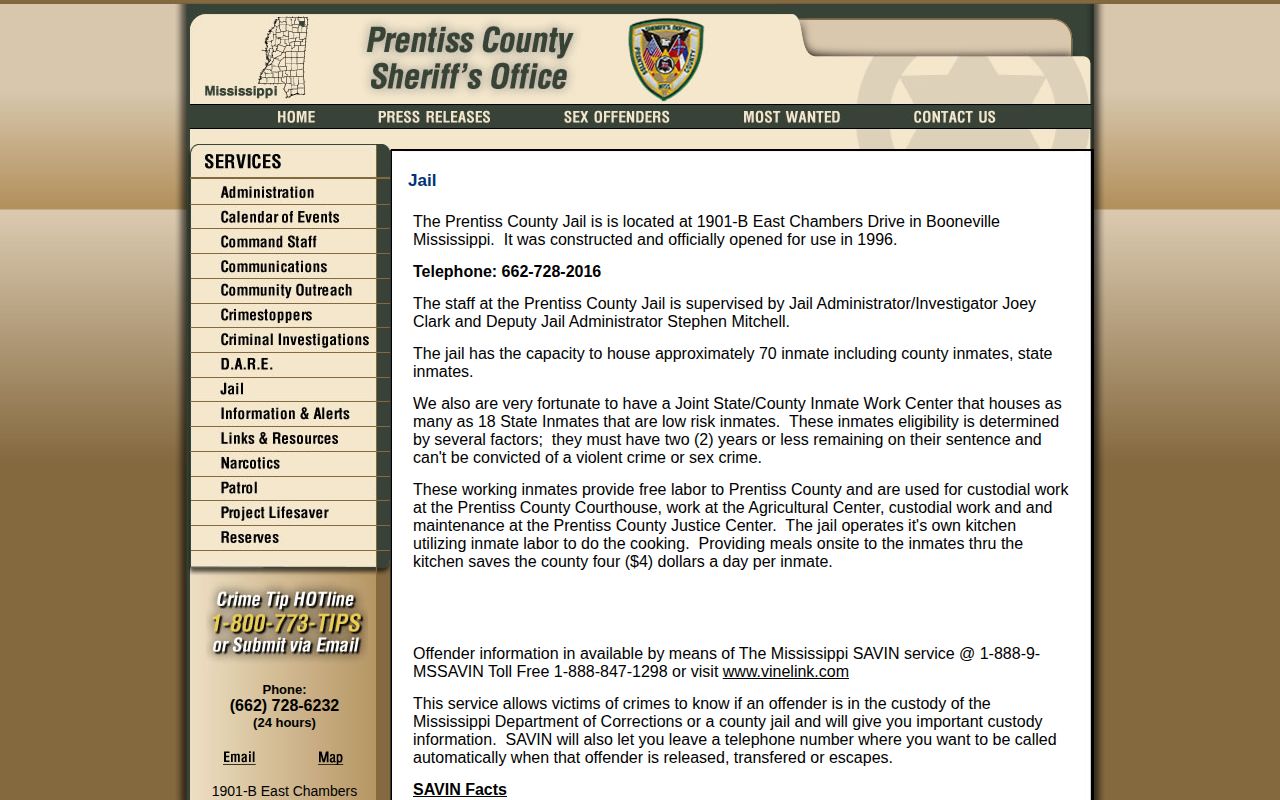
These facts explain why agency labels matter. County custody, state custody, community supervision, and final discharge are separate stages, even when one building is involved.
Note: Facility capacity and work-center placement describe custody operations, not a release date or proof that state jurisdiction ended.
Prentiss County Jail Release Logistics
No verified official source states the release door, processing hours, weekend or holiday rules, property-return process, family waiting area, local transportation plan, or gate payment. Those gaps should be handled by a day-of-release call to the jail. Give staff the person's name and ask what public logistical details can be confirmed. Do not assume that the published office schedule controls a court-ordered or custody transfer event.
Ask whether release processing is complete, whether another authority must take custody, and where approved pickup may occur. If property or travel is a concern, ask about the facility's current process without supplying sensitive details through an open web form. Family members should not use an estimated court time as a gate time. A signed order may still require identity checks, bond processing, paperwork, or a receiving-agency handoff.
For durable proof after the event, return to the jail docket. Record the date and time of any telephone answer, then seek the existing release or transfer entry. That sequence keeps immediate planning separate from the record used to confirm what happened.
Note: Prentiss County has published no local good-time computation, so MDOC earned-time rules should not be applied to a county sentence.