
Joint State/County Inmate Work Center Departures
The Joint State/County Inmate Work Center houses state inmates under a local arrangement with the Prentiss County Sheriff's Office and the Mississippi Department of Corrections. A person who leaves this component has not necessarily been released to the community. The next event may be a return to another MDOC institution, a move elsewhere in state custody, release on parole or Earned Release Supervision, or final discharge. The words used in the actual records decide which path occurred.
Start with the local placement record, then follow MDOC. The local entry can establish when the Booneville assignment ended. MDOC Location, Unit, and Location Change Date can identify the next institutional stage. A Parolee Search result can support an active parole status. Formal custody history or a discharge certificate is needed when the public display remains unclear. The sibling Prentiss County Jail release page covers the different path for county detainees and local sentences.
| Next record | Meaning | What to verify |
|---|---|---|
| Another MDOC location | State custody continues | Location and change date |
| Parolee result | Community release with parole supervision | MDOC number and supervision status |
| ERS record | Physical release under MDOC jurisdiction | ERS start and sentence end |
| Discharge certificate | Documented release or discharge event | Exact terms and effective date |
Note: The end of a Booneville work-center placement is not community release unless the MDOC record shows that outcome.
Confirm Joint State/County Inmate Work Center Release
The best identifier is the MDOC number. Search the MDOC Inmate Search with that number when known, or use first and last name. Open each plausible result and compare the identity, photograph, birth date, county of conviction, sentence date, offense, Entry Date, and sentence length. Then read Location, Unit, and Location Change Date. Those three fields help show whether the person remains in an institution or merely moved within the state system.
Do not convert a location change into a release claim. Also preserve the exact wording of Tentative Release Date, including a blank field. That date is an estimate, not an actual gate time. Search the same person in the separate MDOC Parolee Search. If the public results conflict or stop short of an answer, request custody history, the actual release basis, supervision start, final discharge date, and the discharge certificate.
- Collect the full name and MDOC number if available.
- Compare identity and sentence fields in Inmate Search.
- Read Location, Unit, and Location Change Date as separate fields.
- Check Parolee Search for an active public parole record.
- Request formal history when the displayed status remains ambiguous.
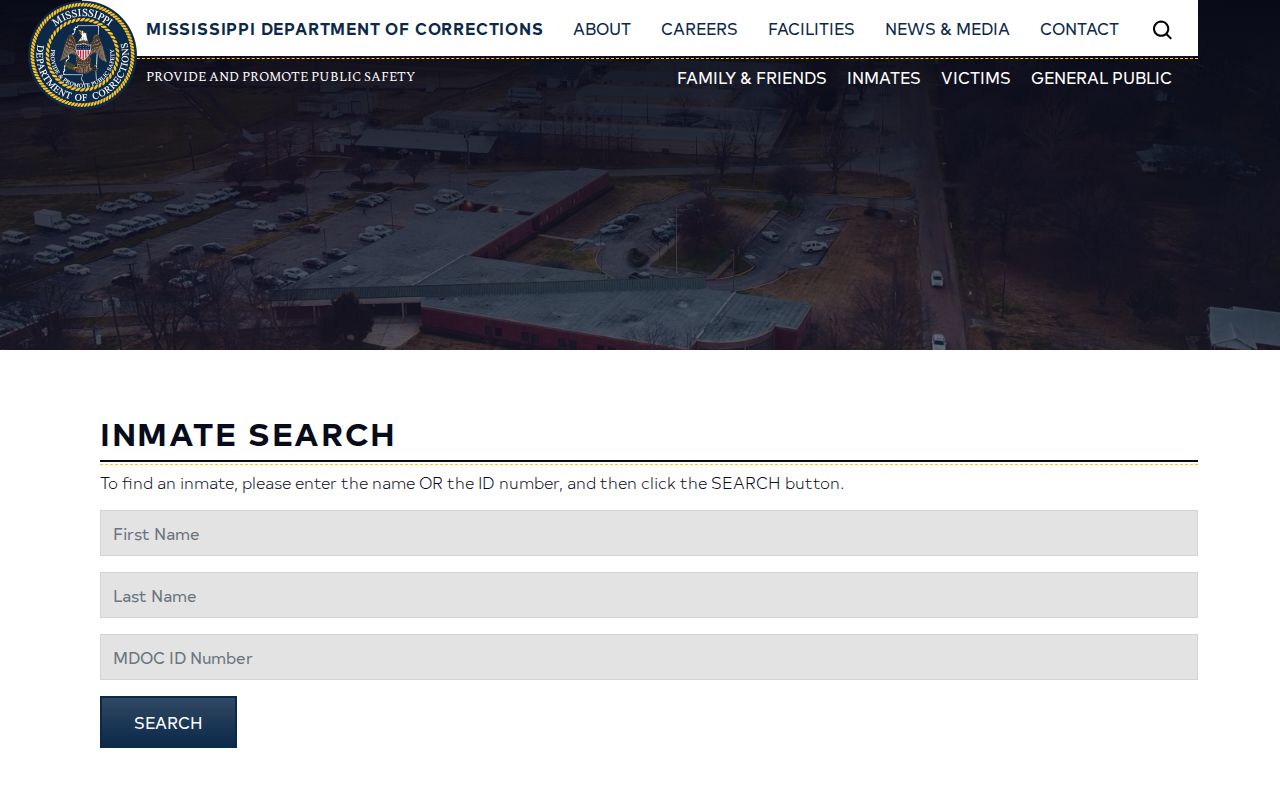
The official MDOC search screen shows the state locator used for this work-center population.
Joint State/County Inmate Work Center Records
The state detail record combines identity, sentence, and location data. Useful observed fields include MDOC ID Number, Entry Date, Location, Unit, Location Change Date, Number of Sentences, Total Length, Offense, Sentence Length, County of Conviction, Sentence Date, and Tentative Release Date. Each field has a narrow meaning. An institutional Location is strong evidence of continued state custody. A future tentative date remains a forecast. A blank tentative date means only that no date is publicly displayed in that field.
The public interface was not verified to keep every fully discharged former inmate searchable under one uniform label. A no-result can arise from spelling, a missing identifier, system scope, or an older record. It does not prove community release. For an apparent release, compare the separate MDOC Parolee Search. County filters can narrow a search, but county of conviction, former custody, residence, and supervision can differ.
MDOC calculates Earned Release Supervision, tentative, and maximum dates separately. The public detail field does not replace the actual custody history. For a projected date, the Prentiss County projected release date resource explains the exact MDOC label and why the estimate can change.
Contact Joint State/County Inmate Work Center
The local contact is Prentiss County Jail because the work-center component is co-located with that complex. Call to ask whether the person remains in the local placement and, if not, what agency or state destination is recorded. The jail line can address the local event. It cannot replace MDOC's state custody history or calculate a state discharge.
Joint State/County Inmate Work CenterCo-located at Prentiss County Jail
1901-B East Chambers Drive
Booneville, MS 38829
Jail contact: 662-728-2016
For formal state records, use the MDOC GovQA public-record portal. Identify the person by MDOC number, full name, county of conviction, cause number, and a focused date range. Ask for custody and location history, the time sheet, actual release date and basis, parole or ERS start, final discharge, and the discharge certificate. The MDOC Records Department also publishes P.O. Box 24388, Jackson, MS 39225; 601-933-2889; and MDOCRecordsDepartment@mdoc.state.ms.us for sentence time, jail credit, and eligibility questions.
MDOC policy lists inspection on working days from 8:00 a.m. to 5:00 p.m. It provides a written response framework within seven working days and production generally by fourteen working days after request or payment unless added time is explained. Paper copies are listed at $0.15 per page, with possible actual labor, technology, mailing, and advance-payment costs.
Joint State/County Inmate Work Center History
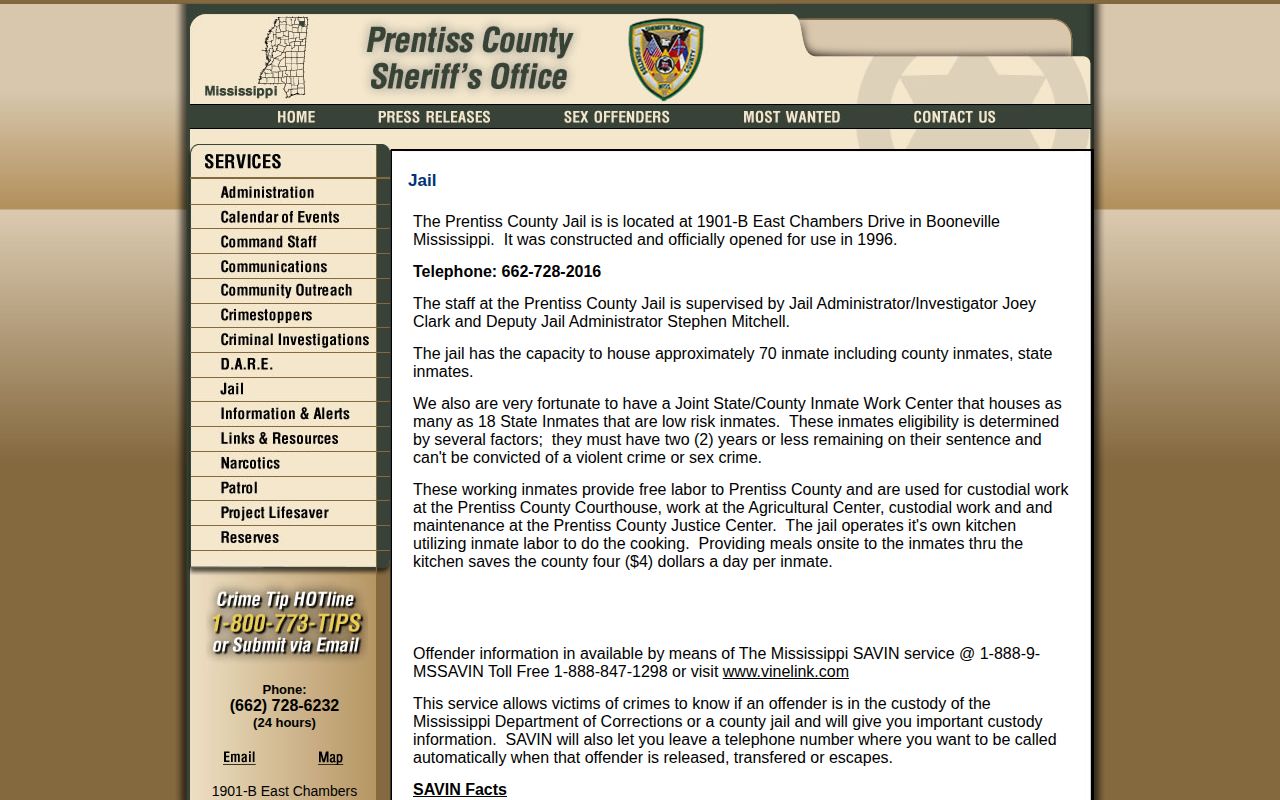
The mixed county and state arrangement is the facility's defining release-record issue. The official jail source says the Prentiss County Jail opened in 1996 and holds about 70 county and state inmates. Its joint work-center component can house up to 18 low-risk state inmates. The sheriff describes participants as having two years or less left and no conviction for a violent or sex crime. These are custody criteria, not proof of release eligibility or a promised departure date.
The official Prentiss jail and work-center source captured below documents the shared facility and local SAVIN route.
Work assignments at county facilities occur while participants remain incarcerated state inmates. They must not be labeled post-release activity, a halfway house placement, probation, or an independent reentry program. The state record continues to control the person's custody status.
Work Center Parole and ERS
Parole and Earned Release Supervision can both follow state confinement, but they are not the same event. Parole is discretionary release decided by the Mississippi State Parole Board. ERS permits eligible people to leave an institution under MDOC jurisdiction before sentence expiration. A person on ERS may retain inmate status and state jurisdiction. Neither label means final discharge.
MDOC states that parole and ERS dates are not guaranteed. Release can still depend on sentence calculations, eligibility, conduct, detainers, residence or travel checks, updated court information, and processing. A Parolee Search result supports a public parole status within that tool's scope. It does not prove when the person physically left the work center, and it does not show final completion of every legal obligation.
- Parole
- Discretionary community release under supervision after a Board decision.
- ERS
- Earned Release Supervision, a physical release that can continue MDOC jurisdiction.
- Transfer
- A move between custodial locations with no community release.
- Final discharge
- The end point shown by the controlling state record, not merely departure from one facility.
Note: Board authorization, a tentative date, physical release, supervision, and final discharge are separate milestones.
County and State Record Split
The Prentiss sheriff and MDOC hold different parts of the chain. A local entry can show the date a person's Booneville placement ended and the destination reported at that time. MDOC controls the state identity, sentence calculation, institution history, supervision start, and discharge documentation. A court commitment can explain why state custody began, but it may not show the time of a later movement.
This split prevents two common mistakes. First, the person did not become a county-jail release simply because the work center shares the jail complex. Second, an MDOC Location Change Date does not by itself establish community release. Match the same MDOC number across records, preserve each date exactly, and note the agency that created each status.
| Question | Primary source |
|---|---|
| When did the Booneville placement end? | Local facility or jail record |
| Where did state custody continue? | MDOC location history |
| Was parole publicly shown? | MDOC Parolee Search |
| What was the actual release basis? | MDOC release and discharge documents |
| Why did state custody begin? | Filed court commitment or judgment |
Work Center Release Planning
No official source gives a separate public release door, family waiting location, property process, local transit plan, or fixed processing schedule for the work-center component. Call the jail for local day-of-movement facts. Ask whether the local placement has ended and whether pickup is appropriate. Do not assume a community pickup when the next step could be transport by MDOC or another custodian.
State release planning belongs to MDOC. Its published guidance says the case manager supplies exact release-date information to the inmate, verifies travel plans, and completes a release process that may take 30 to 45 days. When bus travel is requested, MDOC may purchase an in-state ticket to the destination or nearest city, not out of state. Those practices are specific to MDOC and should not be attributed to the Prentiss jail.
For immediate knowledge, record who supplied the answer and when. For durable proof, request the local placement-end entry and the MDOC custody history. If the person entered supervision, keep the start date and the precise status. If another institution appears, describe the event as a transfer. This two-stage method keeps the local movement from being mislabeled as community release.
Note: Confirm changing movement logistics with the jail while using MDOC records for the lasting custody result.